On May 4, 1970, the campus of Kent State University in Kent, OH was shaken by an unexpected massacre. On that afternoon, unarmed college students were shot out by the Ohio National Guard. Over a very short time span, four students were left dead and nine more left wounded. Students that day were protesting against the invasion by American troops into Cambodia. Unfortunately, people were shot out whether they were part of the protest or an innocent bystander.
How did this horrendous event occur? Well, much of it spawns from the Vietnam War.
The previous year, Richard Nixon became the 37th president and he promised bringing the Vietnam War to an end. Late in 1969, the My Lai Massacre occurred and it would send many into a state of anti-war opposition unlike before. Things were not going as perceived or hoped for the doves of the country. Then in early 1970 it was decided upon to invade Cambodia. The draft lottery had been reinstituted and there was fear from students and teachers alike of their number being called. Going into Cambodia was a sign to those who opposed the war as a way to expand that war into another territory and thus only escalate the war. 1970 would see several campuses protest the current situation involving the Vietnam War and Kent State was no different.
April 30th would set the dominoes in motion. On that day, President Nixon announced that the Cambodian Incursion had been launched. The next day, about 500 students held a demonstration in response to the action. At the conclusion of the day, it was decided that there would be another rally on May 4th. That night, though, many began to riot and set places on fire. The actions called for a state of emergency and police forces were on guard. The following day, the National Guard was called in and arrived that night. Demonstrations, riots, and all types of chaos was still taking place including the ROTC building on campus being set ablaze. Then on the 3rd of May, Governor James Rhodes called out the protesters and denounced their actions. He used many horrible comparisons to the point of referring to anyone involved as being Un-American. Due to the ongoing proceedings, a curfew was set in place and guardsmen had to continue dealing with protesters.
Then came May 4th. A protest was still planned from the 1st and University officials hoped to curb it from happening. They hoped to spread the word that the rally was canceled. Despite all those efforts, roughly 2,000 people gathered on the university's center. Once gathered, National Guard companies were called in to monitor in anticipation of what might occur. Guardsmen approached students in hopes of getting them to disperse, but were greeted with hostility and things thrown at them. The Guardsmen tried once again and were met with a similar response. This time they began to put pressure on the students and the students began to march away as a way of escaping the National Guard. Taylor Hall was the common building during most of all of this. The students would march towards an athletic field and continue to make their statement. The Guardsmen, then, used their firearms to get the students to scatter and disperse. They were able to get many to retreat, but a bunch still refused to be removed. This would soon lead to a chaotic scene.
Early that afternoon after a couple hours, members of the Guard began to fire at students. 67 bullets were fired amongst the 29 guardsmen who shot their pistols and rifles. The firing only lasted 13 seconds, but felt much longer for those there. It is still unknown what truly provoked the necessity of the firing. There are disputes to this day whether a call to fire was ordered or not. Some of the Guardsmen felt worried for their lives. Still it might be viewed as a drastic measure to fire at unarmed students.
The results? Four dead, nine wounded. Allison Krause and Jeffrey Miller, two of the four who died, were involved with the protest. Sandra Scheuer and William Knox Schroeder, the other two who died that day, were just going about their normal Monday schedule and heading to class. The average distance away of those shot was 345 feet from the Guardsmen. Miller died instantly, Scheuer died a few minutes later, Schroeder died an hour later, and Krause died later that day. The names of those wounded: Joseph Lewis, Jr, John R. Cleary, Thomas Mark Grace, Alan Michael Canfora, Dean R. Kahler (left paralyzed from chest down), Douglas Alan Wrentmore, James Dennis Russell, Robert Follis Stamps, and Donald Scott MacKenzie. Their fellow classmates were ready to launch an attack geared towards the National Guard. However, some teachers were able to get the students to finally back down and allow for medical care to come in. Only one Guardsmen, Sgt. Lawrence Shafer, was injured during the day's proceedings.
As the media got a hold of the events, it gained the national spotlight. It only increased the anti-war sentiment regarding Cambodia and the Vietnam War.
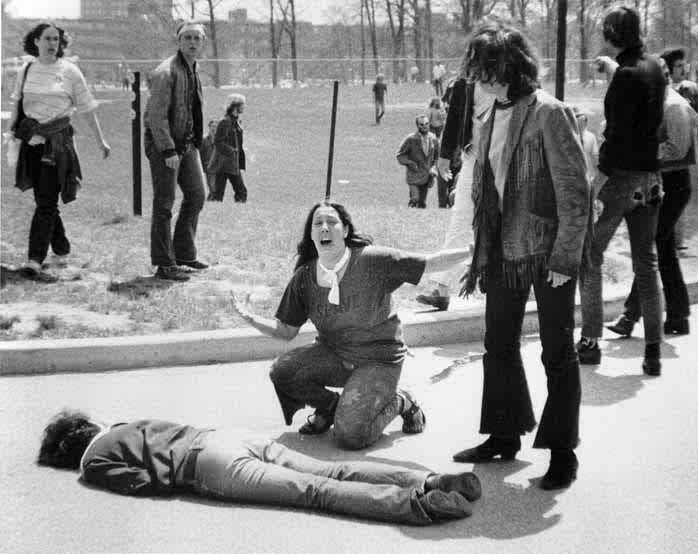
This picture became a symbol of the massacre: http://digitalrhetor.files.wordpress.com/2009/05/kent-famousphoto.jpg
The shootings at Kent State would set in motion several student strikes at campuses across the country. Roughly 450 campuses shut down from both violent and non-violent protests. Students across the country were uniting against the war and the actions at Kent State. Signs like "They Can't Kill Us All" were hung from dorm windows. An antiwar protest was held in New York City four days after the shootings. Its purpose was partially geared from the actions earlier that week at Kent State. Protests took place the following week in Washington D.C. against the killing of unarmed student protesters. The White House was so worried for President Nixon's life that they removed him from the city and hid him at Camp David for a few days until the situation quelled over. The war had reached a boiling point in America and now the young people had something to truly spark their fire. 4 million students were reported to be protesting as over 900 American colleges and universities were shut down in reaction to the strikes. This was the first and only national student strike in the wake of the Kent State shootings. Nixon's response did help matters as he was perceived to be callous and unemotional about the death of students.
Vigils and responses occurred in the coming days. Most looked to the students as the ones who should garner the blame and many in the National Guard were remorseful that deaths occurred, but felt that the actions were a last resort after attempting other methods.
On May 14th, at Jackson State University, two students were killed and 12 were wounded under somewhat similar circumstances. This incident did not garner nearly the attention that Kent State received. As a result of both incidents, President Nixon would establish the President's Commission on Campus Unrest in June to address and study these protests and reactions. The verdict? The Ohio National Guard was unjustified in their use of lethal force against unarmed protesters.
The actions by the Guardsmen that May day have changed the way that they handle protests, riots, and similar situations like the riots in L.A. in the early 1990s. Two of the wounded; James Russell and Robert Stamps; have since passed in the last couple years. Each May 4th, those affected and those on campus remember that day.
Now, I cannot verify how vicious the protesters were that day. How come they were not allowed to peacefully be left alone to protest against the war. Yes, they did burn and destroy campus buildings along with surrounding facilities. And yes, they should have been monitored. But to be shot at?
I can almost relate to the students at Kent State that day. I attended Rutgers University for four years. Throughout all four years, we (the United States) were engaged in not one, but two wars in the Middle East. People my age were losing lives and sacrificing their futures for this country. I respect each and every one who decided to make that decision. Unlike in 1970, there is no draft lottery today. However, the Iraq War is/was as unpopular as the Vietnam War for my generation of college students. During all four of my years, there was a rally/protest against the Iraq War. Each spring around the anniversary of the day the United States invaded Iraq events are held. It is called Tent State. For a week, speeches and conversations are held. Veterans come in and talk. Memorials are held. Then there is a march down the streets and around campus and town to bring light to the unrest regarding the war. During my time at Rutgers, the worse thing that happened was three students were arrested for their actions; non-violent actions.
I respect all my fellow students decision to protest and rally against the war. Back in the 1960s and 1970s, it was the college students who were the most vocal against the war. They were the ones who were first in line to get set over to Vietnam for what seemed like a loss cause. Then, the events of May 4, 1970 occurred. Those four dead could have been anyone. Two of them were not even involved. Personally, the shootings that day have left a stain during that time. Young individuals felt pushed to the brink and that was their response. The legal system exists for a reason; that is how you punish those who go a little too far. None of the protesters had anything deadly on them. Shooting should not have been the answer, but you can't go back and change it.
Unfortunately, four had to die for eyes to open and actions to change moving forward. Having a country of college students unite together showed then and could show today that young people can stand up for something and make a statement. So, remember those who died and were shot that day and not be afraid to stand up for what you believe in. We are given freedoms under the Constitution and those students that day utilized them.

Subscribe to:
Post Comments (Atom)


No comments:
Post a Comment